Wednesday, September 3, 2008

Basement Shop Progress Pics 2008.09.02


Finally got the cyclone mounted up and it runs fine in its new position. This time I used the stand - I looked into wall mounting but didn't feel comfortable with the type anchors I would need in the block wall. An alternative would be to build a torsion box wall for the unit to attach to, but after calculating the amount of room it would also take, it made better sense to just use the Grizzly-made stand.


Note the cut-out in the ceiling to clear the motor housing. It's wrapped in insulation to cut-down on noise and I was careful to isolate the entire unit from touching the walls or ceiling, to help cut-down on vibration. It's still loud, but mostly from the on-rush of air, rather than from the unit itself.


You might wonder how I got this guy assembled - normally you would put together the bulk of the cyclone on the stand on its side, then tilt it up into position (the manual recommends 3 people). I didn't have that luxury both in man-power and in ceiling height. I noodled this one for a while before coming up with a method that worked. I first built the top of the stand and attached the cone and impeller housing before laying on its side. Next I built a wood platform with castors that fit inside the stand. I then tilted up the whole unit until it stood on the wood stand and set the motor and impeller on top, attaching with the supplied bolts. I next rolled into position. Once in position I was able to determine where the cut-out for the motor needed to be and I could finish up the ceiling with the unit rolled out of the way. Once that was done, I rolled back the unit and slowly added blocking to front and back, raising up the whole unit the thickness of a 2x4 at a time. This took some time and I did have one accident where most of the blocking fell and the unit crashed into me - luckily the back edge was still supported and I was able to hold the unit up until I could get blocking back under it (I do have a nice large bruise on my left arm as a temporary record of the event).

Once the unit was up about an inch higher than the bottom stand legs, I nudged the wood support until I could get the right back leg attached, the nudged and rotated the stand until I could get the opposite leg attached, rolling the stand towards me so the back corner leg was exposed. I put a 4x4 block "leg" under the front corner for some extra support and attached the leg in the back corner. Using this same support I rolled out the stand, holding the unit upright to pass the temporary leg. I finally attached the front leg and was able to tighten everything up - I ended up needing to shim the front leg to accomidate differences in floor height to level. There were a few moments in there that caused the ole sphincter to tighten, but it wasn't too bad. I did feel like I had been in a fight the next morning with soreness all over. Nothing like holding up 300 or so pounds of top-heavy metal by yourself while maneuvering around, with a possibility of the whole thing falling on you at any minute to get the stress up.

Finally I attached the filter and placed the dust canister underneath. One thing I didn't think about was the need to remove the cannister - I'm going to have to keep space open next to the unit so it'll roll out. I'm thinking right now of placing a piece of wheeled equipment there so it can easily be moved for dust canister removal.


Here's a close-up of the motor cut-out. Everything is well wrapped in HVAC metallic tape, as are all seams throughout the ceiling - this is to isolate as much dust as possible from the rest of the house.


I also started working on one of the metal/wood workbenches I picked up in that haul that included the Walker Turner sander. This bench was pretty rough - paint flaking off everywhere on the metal stand as it had been painted an institutional green. As the underside showed a gray I decided to go with Rustoleum Dark Machinery Gray, over brown primer. The entire stand was first sandblasted to removed as much of the old paint as possible - it's not perfectly smooth but it'll do as a working table.
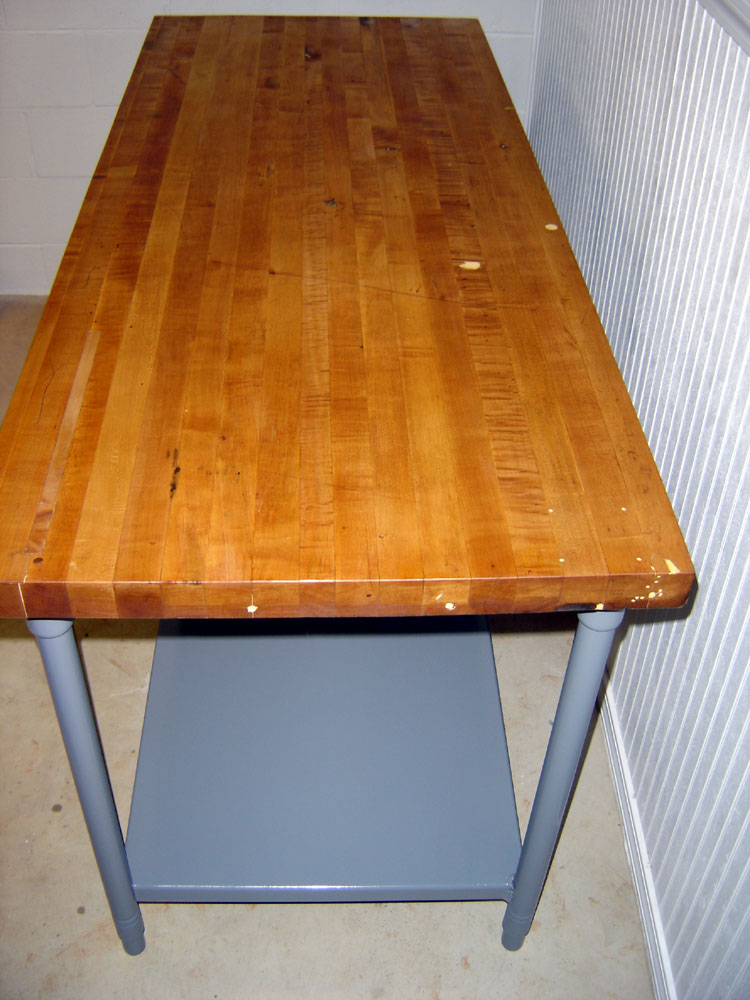

The idea was not to get this to furniture quality, but rather to create a reliable work surface without paint flaking off everywhere. To that end I also sanded and filled the maple butcher block top - it had actually been flipped at some point so the worse surface is face-down - it's filled with hundreds of drill holes, cuts and scrapes. It must have been used in a metal shop where people liked to use it to support drilling - it also had numerous burns and spills saturating into the wood. I got off most of the muck (oil and metal shavings) using 80 grit (both sides), filled the worst holes then re-glued/clamped some strands that had delaminated, before I surfaced again with 80, following up with 120 and 220 on the top and edges. I also replaced the missing threaded rods that hold the ends together (3/8" threaded rod donated by fellow GWA member, Tommy Roland - an artisan if there ever was one and nice enough to share his knowledge and experiences). Here's a side view after one coat of BLO.
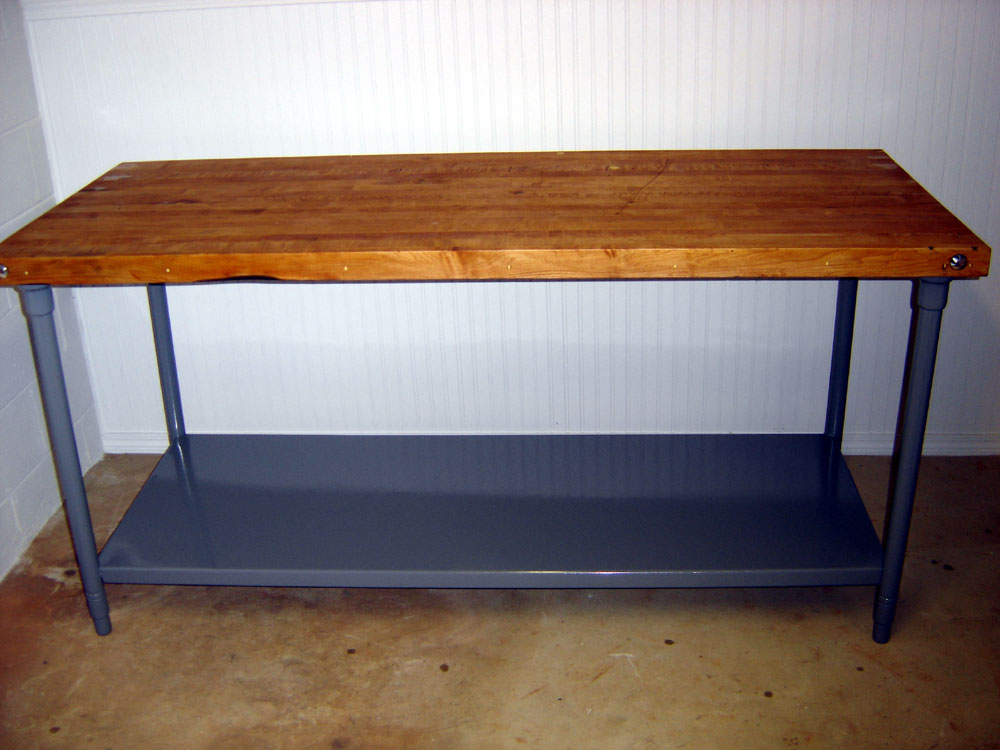

I plan to put 2 or 3 more coats of BLO on the wood portions before waxing with paste wax. I prefer the natural oil finishes for something like this that will get banged on, rather than film finishes that would crack with constant pounding and use - after all, it's not fine furniture. I've also completed about 1/2 of the space as far as sealing with HVAC tape. Still to go is sealing the rest, re-hanging my lumber on the standards you see in the pics, hanging the ambient dust collector, the ducting and some task lighting. Oh and placing the equipment - there's still that.

-- John

Monday, August 18, 2008

Basement Shop Progress Pics 2008.08.11


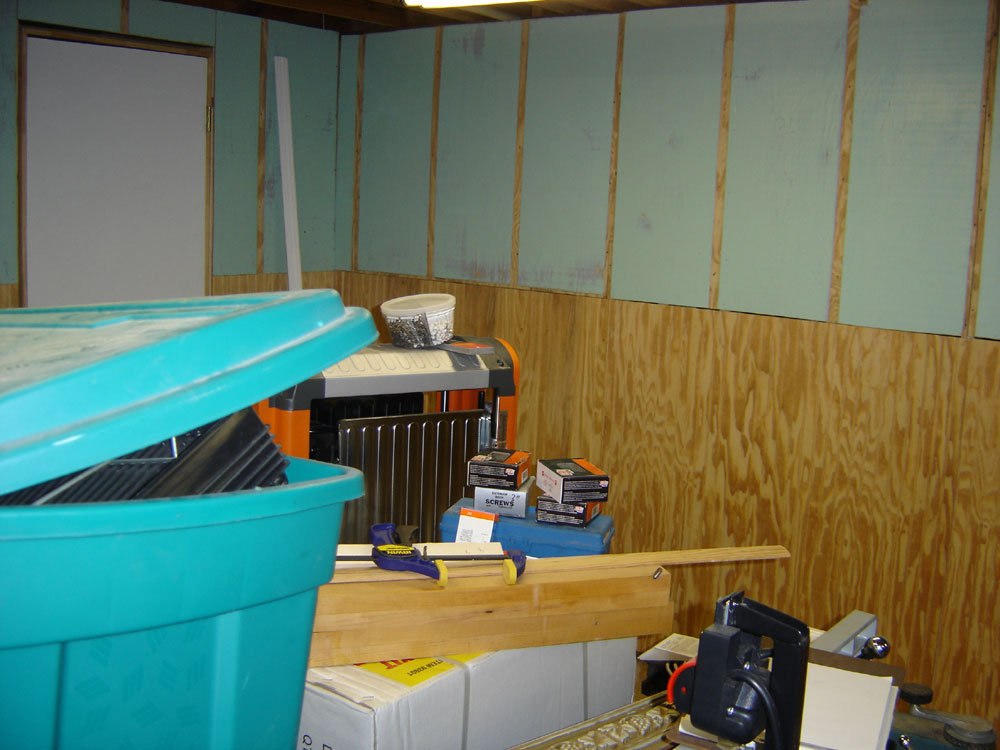
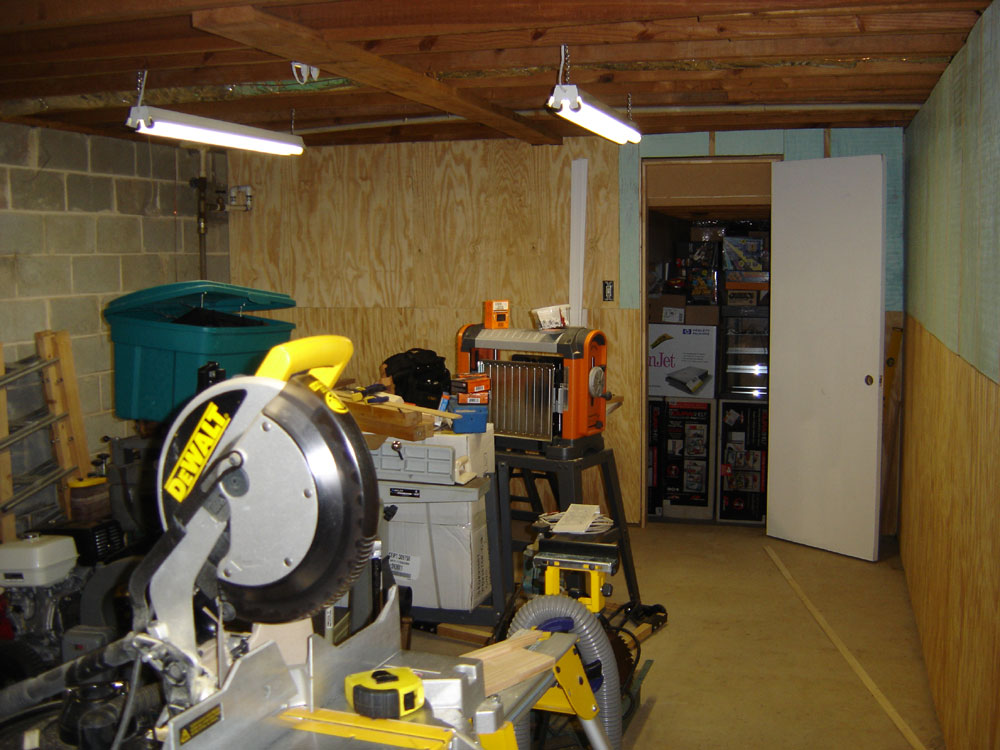
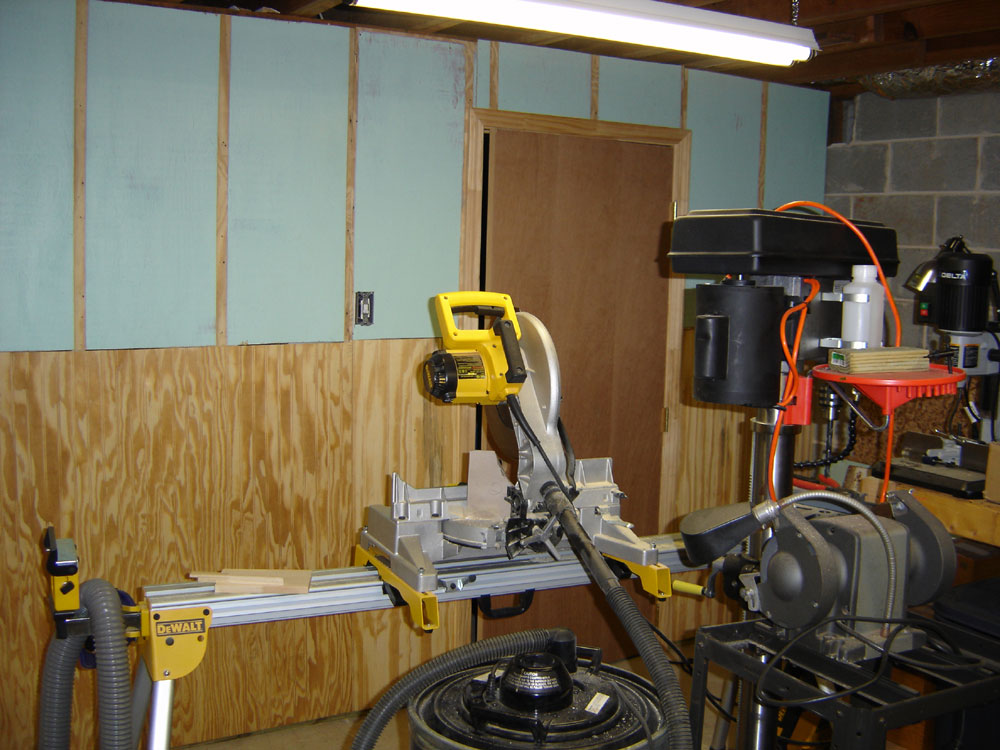
Here are some of the latest progress pics - things are going along slowly but surely. The image above shows what I'm doing with the ceiling - to improve sound dampening I put some R30 insulation between the joists and am using some foam-cored 1/2" board. It's sort of a mega-ceiling tile that's screwed in with taped joints (that's metallic HVAC tape). Each piece is hand-fitted to eliminate gaps - the idea is to provide something that's removable but still blocks out dust and as much noise as possible - the foil backing should improve the lighting a bit. I wired everything to a 100 amp sub-panel with 3 dedicated 20 Amp 240 circuits - you can see in the photos the metal conduit drops on the block wall (exterior of the house, underground). I also have my old shelving standards along the block wall which are attached using a hook at the top and then Tapcons into the block. Speaking of the block wall - originally I wasn't going to paint it but with everything else going on I decided to hit it with a couple of coats of DryLox - it should create a more stable environment.


I also brought in more of the wood I had stored out in the carport so it would start acclimating to the change of environment - my basement is at about 50% humidity via dehumidifier - much less than what is normal in the Atlanta climate. You can see the pile peeking from behind the stack of equipment in the next photo.


I guess I should mention the Grizzly Dust Collector - it's a 2HP Model GO440 - don't think I have in previous posts. I purchased this on CL super-cheap from a guy in the Florida pan handle. Seems he was looking at it on the Grizzly site and said something about wanting it - his wife overheard him and bought is as a surprise Christmas present. He hung it on the wall in his garage shop then realized his truck wouldn't fit in the garage - so it had to go. He started the pricing fairly high, then week by week started lowering it - when it got to something I felt was worthwhile I wrote the guy and asked if he ever came up to Atlanta - turned out he had a cousin in Noonan and was willing to bring it up - I met him with my trailer right off an I85 exit. He had only partially disassembled it, which will make it super easy to reassemble. Considering I was looking at units in the $1K+ range for my needs, I'm very happy to have found this.

In photo 2 you can see the space in the far corner - that's where the cyclone is going - I was originally going to put it in the adjoining room but had some worries about the furnace and other pilots there igniting any fine dust - there's also a large beam and ducting which would have been routing the DC ducting troublesome so I opted to take up some of the precious space in the shop area. I originally thought about a wall mount but by the time I figured out a hanging method it made more sense to use the Grizzly stand. It sticks up between the floor joists above so I've wrapped the area in a box-shape so the motor is isolated - there's additional insulation to help with noise. I've actually made a bit more progress than this so I'll have updated photos soon.

-- John

Saturday, May 24, 2008

LatheFront


LatheFront
Originally uploaded by johnnyapollo
My latest find is this late 30's Boice-Crane 46" Gap-bed lathe. This one is rather special with what looks to be the original paint (complete with labels), tail stock, tool rests and extra spindles. This is the first I've seen with metal legs and it's pretty much a user (after a little clean-up).

Sunday, March 23, 2008

Latest Acquisitions 2008.03.23

Thought I would take a moment to describe the latest in old 'arn that I've gotten over the last few months.


First up is this 24" Rockwell Scroll Saw Model 40-440 Serial Number FP-1467. This was from a Craigslist ad listed for $75 - reduced to $65 because the seller couldn't find the insert (ended up buying one from an OWWM member for $8). I'm not showing the stand, but it was also included - typical Walker Turner/Delta/Rockwell with splayed feet and square bolts. This example also comes with the cast belt cover but not the light (one could only wish - those are going for crazy money these days). It also has a magnetic switch installed so it was probably used in some production environment (guessing there). Very nice Delta/Rockwell motor with knurl for hand turning.


I've been looking for a while for a cast iron stand for the 6" Delta Joiner (see earlier post) and finally found one - in this case with a working joiner attached! The joiner is missing some parts and has some slop, but does have the coveted porkchop guard - I may end up parting the joiner and concentrating on the earlier one I purchased. This stand is fairly complete (has both back covers and 2 knurl knobs). I haven't removed the motor but it's a beast and probably better than the one I got with my other 6" joiner.


Next up are a couple of old hand-drills. The 5/8" Van Dorn I ended up getting while picking up a Rockwell Radial Drill Press (I'll have pics up in a later post - forgot to take them). Got it for $25 - it's slow but has tremendous torque.


I picked up these two hand drills at to separate yard sales for a couple of bucks a piece - both are Craftsman - the one on the left is the better of the two and has replaceable bushings.


Found this Franklin Electric motor converted to a single disc grinder. It was $5 and I figured I could use it for something.


I spotted an ad for a few misc. 3 phase motors and in the middle was one listed as a "driver" so I took a chance that it was a Walker Turner - turned out I was right. It also came with the reversing switch - I'm not sure what it was used for - at first I thought a shaper but at 1/3 HP probably not. Not bad for $10.


That's it for this post - I still need to take some pics of the Rockwell Radial Drill Press I picked up, as well as a Sears Dunlap 8" table saw. I'll have those posted soon.

-- John

Thursday, February 28, 2008

My Basement Shop Construction - an Introduction

I thought I needed to start writing a bit about my shop construction. About two years ago I finally decided that something needed to be done with all my tools. I had been pulling my tools out into the yard to do anything "dusty" like cutting trim, ripping on the table saw, etc. It's a bit of a pain but clean up is relatively easy - I can pull the hose from my compressor and hose off everything before pulling equipment back inside. The only issues were with weather and waning light - if I got caught in rain it basically sucked, or if it got dark on me it made it a lot harder to complete a project, so I ended up being rushed right when I probably shouldn't be - this compounded mistakes. So I started looking at my basement and how I might leverage some of the space for a workshop. I decided that I could hook up a dust collector and do some stuff inside, but it took a bit of ingenuity as there wasn't a lot of space to move lumber around, especially sheet goods. So at the time the DC was only used for my bandsaw (I would occasionally use my miter saw inside, but the shop vac worked better at collecting the dust shot by the blade back to the built in port). At the last house, I erected a 12x16 workshop on the side-yard. At some point I might do something similar at the new house, but for now it's a lot more economical to put something into the full basement.

My house is about 2400 sq ft of finished space, with a full basement (400 sq ft of the basement is finished, which leaves about 2000 sq ft of storage or potential work space). The basement is peculiar in that the floor has two levels - the center of the basement mimics the sunk-in floor of the living/dining/kitchen area above (so each end of the basement appears to have a raised floor, when one is looking across the entire space). The ceilings are also fairly low - about 72" to the bottom of the floor joists above from the poured concrete slab. This provided some challenges. There is an addition that expands the master bedroom, with a "gardening" room below, which I use to store yard tools and other 'crap.' This room also has an exterior door that opens to the back yard, with the original door to the house separating that space from the rest of the basement. The old door is hollow-core and badly delaminating - more on that later.

So my initial thinking was to take the back quadrant (actually a sextant if you divide each level by two front-and-back) of the basement by the back door/"garden room" to build out. The space was about 13'x33', but I would have to factor in space for the furnace and hot water heater, which were also in that area. I started a floor plan and also began a materials list. That's when I realized that enclosing the furnace, etc would really limit the space and take a lot of extra time to do. Plus the doors I would need to install would be in awkward places, further limiting the available space. The solution was to use the adjoining space towards the front of the house. The only issue being the need to move my boxed and palletted book collection elsewhere. So the challenge was to consolidate my collections and bring them towards the furnace space, while leaving enough room for pass-through and access to the house systems (furnace, etc). That took a bit of thought and brought me up to early last year.

Starting about October of 2007, and committing to building out the front sextant of the basement, I began making some plans. First, I wanted to keep costs down while having the most flexibility. I also wanted to reuse some of the lumber and sheet goods I had accumulated and saved that was now taking up valuable space. The room ended up being rectangular at about 13' wide and 33 feet long (two walls are cinder block foundation while the other two are limited by the drop in the floor on the short end, and a demising support through the center of the house for the long wall). There would be two doors - one opening up into the bulk of the basement, and the other approximately in line and the same size (32") as the door leading to the "garden room" (no need to have the door larger than the exterior door as anything built to move outside would have to exit through the exterior door). I would also replace the door into the "garden room" for better security, change this door and exterior door locks to mach and work with the same key; and finally to rework the house alarm so I could enter through the back and input an alarm code, instead of coming in through a normal exit and having to disable the alarm from the first floor.

I would also wire the room with at least 3 240v 20 amp circuits and 4 120v 20 amp circuits, with lights wired into the regular house wiring via 2 120v 15 amp circuits (good idea to have lights on a separate circuit in case there's an issue or need to disable the sub-panel). The idea is to have enough power to leave equipment plugged in with one circuit dedicated to dust collection. More than likely I wouldn't have more than one or two pieces of equipment in use at the same time, so it became a "power management" exercise. Through all this I did a lot of research on what other woodworkers did - what worked and what didn't, and made some decisions based on my research and needs (woodnet.net is a great source for ideas, as were Google searches). The lights would be suspended and plugged into switched outlets, so they could be moved for best effect once the equipment was laid out. Also, the receptacle would be located above 4' from the floor, in case sheet goods were laid against the wall it would prevent them from being covered.

I had enough left-over bead-board from previous projects so I would only need to buy 1 sheet to complete the two walls, I also had enough salvaged plywood to sheath most of the walls, that came from part of a neighbor's addition that had rot along the bottom (cut off the rot and the bulk was still usable). I purchased some interlocking floor pads at Harbor Freight (4 pack at $5.00) so most of the walkways would be comfortably covered. The walls would be painted and I would have lumber racks on two of them (I have a stack of Walnut and Sapele currently in the carport along with a pile of misc hardwoods like purple heart and mahogany, so the racks would need to be able to store at least that amount).

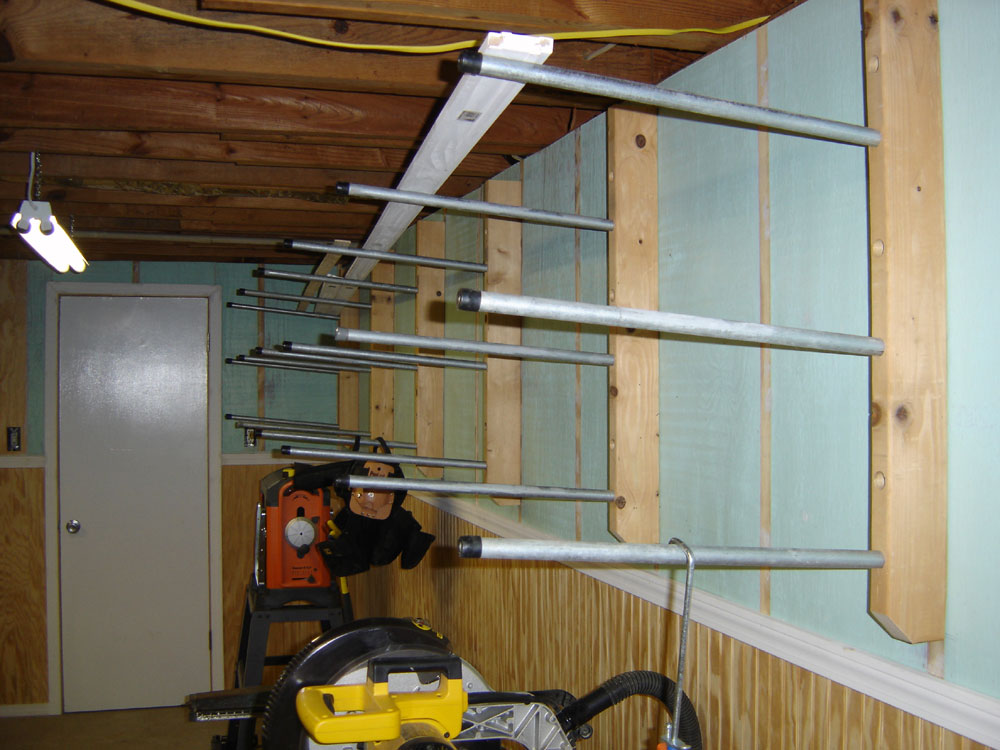
I started collecting materials as soon as I knew roughly what I wanted to do. I started scouring Craigslist and saved a lot there. I got lucky and found a 100 amp service panel to use as a sub on CL for $30 complete with the 20 amp 240 and 20 amp 120s that I needed. I also bought a box of misc electrical supplies including 250' of 12-2 wire, nail-in and remodeler-boxes, wire nuts, switches and outlets for $30 off of CL. I still needed a 100 amp breaker for the main panel - a Cutler Hammer (which happened to have the most expensive components - go figure) - the retail for that breaker was more than $100 but I managed to find one on eBay for $25 shipped. I also just recently found a pre-hung metal clad exterior door on CL for $40 to replace the delaminated one. Of the two doors leading into the space, I bought and modified a hollow-core pre-hung for the entry from the basement, while the other was a salvage from one of my neighbors who replaced all his doors - I just had to buy a door-frame kit that was fortunately on sale at Home Depot for $14). All this helped to keep costs down. Finally, I found some lumber racks made of 2' galvanized pipe angled (about 5 degrees) into the edge of 2x4s with lag screws - 9 of those were $25 (and I managed to score a bunch of woodworking mags and books for another $25). I modified those for my shop racks, attaching them to the long wall I built so I've got about 20' of usable wood-racking on that wall. I used some John Sterling standards and brackets on the block wall - those were all on close-out at Home Depot so were very cheap.

Some other considerations include soundproofing (sound travels and is very loud in the rooms above) and some type of ceiling sheathing - I want to use something thin and reflective to not lose ceiling height and improve visibility. Also, with stationary machinery it makes sense to go with ducting to the Dust Collector, which in itself won't be powerful enough for my needs (there goes the budget!). All along I've been picking up used equipment to use in the shop, so I've relatively got everything I want (there is some opportunity to swap out some things for better or old arn, as the case may be and I'd like to have a metal lathe but those are all outside the scope of the shop design and build). I also created a small space in the pass-through area to use as an office, mostly to store diagrams, magazines and woodworking reference books. I might also commandeer some additional basement space to store wood and unused/project tools. I'm also leaving my automotive tools outside of the woodshop to free up space and make things more efficient - though there may be room for some exceptions. Finally and perhaps the most important, is to seal everything up to prevent the escape of dust into the rest of the house - so I'll be spending a lot of time closing up cracks and gaps, and caulking seams.

Unfortunately, I didn't take any shots of the space before I started putting up walls - the two walls were basically studs on 16" centers, with the top plate attached to existing floor joists and the bottom plate attached with Ramsets into the concrete. I then sheathed using the left-over bead-board and recycled exterior 3/8" sheathing - note the paint, the lines are where battens were nailed to the exterior. These images were shot on 2008.02.06:


I salvaged several doors that one of my neighbors was throwing out - he had replaced all the interior doors with new, so I reused on 28" door for the short wall. I bought a pre-hung 32" door for the long wall so it would be the same size as the door leading out of the basement. Note the position of the four 48"x2 bulb lights - you can see the outlets mounted on the wall - I zip-tied the cords so there's about an extra 2 feet of range for repositioning. You can see the light switches in these two photos - 3-way so the lights can be turned on/off from either door. The pre-hung had to be shorted about 8 inches to clear the supporting beam on that wall - I now wish I had taken a bit more time and shortened it from the top instead of the bottom - the knob is lower than normal - not uncomfortably so, but it is a nagging detail. I'm not sure if it was worth all the extra time it would have taken to modify both the door and frame - it would have been easier starting with base components (I think I would have if there was a 32" door in the salvage pile, but alas the largest was only 28 inches wide).
I then shortened the wood racks mentioned earlier and lag-screwed them into the new studs - the top screw goes into the supporting beam the top of the wall is attached to. These shots were taken on 2008.02.19:


Because of space considerations, I'm building my Miter station along this wall beneath the racks - it will actually be a bit shorter than usual to clear the bottom pipe. The drill press will be placed in the corner behind the door.

-- John

Friday, October 26, 2007

Tools from September 8th 2007

I went to a really unusual estate sale on the 8th - the basement was full of old tools that had belonged to the home owner's father. Amongst them where the following:

Walker Turner tabletop Drill Press
Delta tilt-table Table Saw
Craftsman 1/2" shaper (unusual, cast iron round table and guard)
Boise Crane snowflake Bandsaw (looked to be 12 inch) table top model
Walker Turner bench grinder
Walker Turner Sanding Machine setup

There were also several work benches, bits and pieces, hand tools, etc. there was also an assortment of small old motors and many threading taps. Looking over everything - the pricing seem pretty close to what I would expect collectible retail to be - for instance the bandsaw was priced at $400 - the drill press had already sold so I'm not sure what it ended up going for. The table saw was priced at $350, etc. The sanding machine setup was the thing that interested me, as I had never seen anything like it - it had $350 on it and apparently I was the only one interested as I'm to pick it up the following week for $200. It came with what looked like most if not all the parts plus two original WT wrenches (and the dust collector underneath)

More images from the original CL post:


This is what I ended up bringing home:


Includes the two tables (one mounted with the sander), the WT sander, the Craftsman Shaper and a box of handtools, sand paper and bits.

Detail Pics of the Sander:


It turns out that the sander is a Walker Turner SM900 and is actually pretty rare. It came with a little vacuum and bag that hangs underneath (the bag is ripped though - dry rotted) - you can see it in one of the photos of all the parts. It also originally had a sliding table (I've got the two rails) to make it into a stroke sander - I think the table was in the basement stacked on some other things. The "stroking block" might have also been amongst all the bits but I wouldn't have known it was part of this setup.

The Craftsman Shaper is also unusual. It appears to predate most of the numbered tools you usually see produced by Sears. It's entirely made of cast iron, stand, table and fence. The base has "Craftsman" "14" Bearing" and the "Patent Number 1893080" I looked up the patent and it was assigned to C.A. Roberts in 1932. The blue paint looks to be original.


Turns out that this is a Craftsman branded Herbert's Shaper. Patent Link: http://www.google.com/patents?id=w3s_AAAAEBAJ&dq=1893080

-- John

Friday, October 5, 2007

Some tools I acquired on 9/12

Figured I should do an update - I picked up a few items on 9/12:

There was a gentlemen down in Florida that posted looking for a home for a Dewalt RAS - he was looking for someone who would appreciate it as he didn't have it in him to restore or even use it - the price was "free." When I saw the post I PMed him and told him if he couldn't find a new home for it, I had a friend that didn't live to far from Vero Beach (where he lived) and I thought he wouldn't mind picking it up for me. I was contacted a while later as no one else offered to take the saw - he also pitched an old Drill Press he wanted $50 for - a Champion Blower and Forge 50E (there's a couple of images on OWWM.com) - I thought it was interesting and hey - anything that looks kinda like a sewing machine couldn't be all bad. My friend Joe Black picked up the tools some time ago and came to visit during that weekend - how's that for a Rucker from someone who doesn't know what that means?

Dewalt MMB-23 - complete/working with wrench. Has some rust but nothing a little electrolysis can't fix I don't think:


Champion Blower and Forge 50E - interesting old DP - has an old working GE motor, probably from the same era:

Second set of tools came from an Atlanta CL ad - it showed a blurry picture of a mess of tools on a table - I could make out a small Delta Jointer and figured I couldn't go wrong for $50.

Included were:

  • Dayton 14" DP Model 3Z305
  • Delta Rockwell Homecraft 4" Jointer with an old Serial Number tag F-4768 working w/motor
  • Craftsman Lathe 103.23881 with rests, original CMan Motor and turning tools
  • Couple of cheapie grinders, oak mallet and an old metal hand drill:


-- John